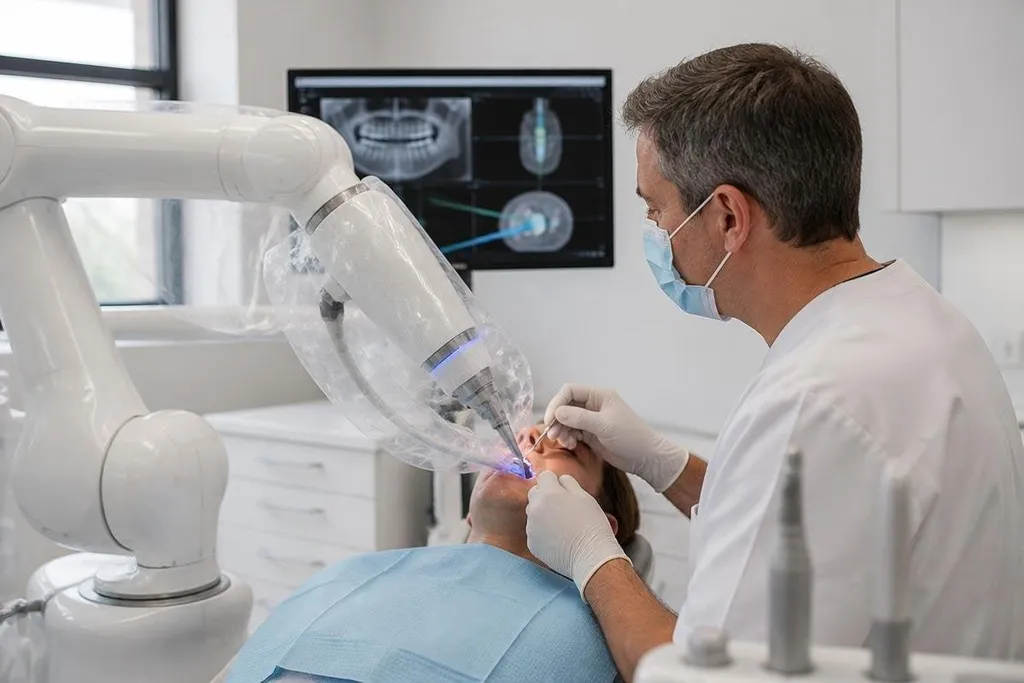
A dental robot can hold a drill, guide an implant, or move tools during a planned procedure. The dentist still sets the plan, checks the patient, and stops the system when conditions change.
The useful question is where robotic control adds value, and where a trained person must stay in charge.
- Implant placement: software can turn 3D scans into a planned drill path.
- Dental labs: robotic machines can mill crowns, bridges, and other parts.
- Patient care: the dentist remains responsible for diagnosis and treatment.
Where robots fit in a dental clinic
Most dental robotics begins with digital records. A cone-beam computed tomography scan, known as CBCT, shows the jaw in 3D. An intraoral scanner records the shape of the teeth and gums.
Planning software can place these images in the same model. That model gives the dentist a planned location, angle, and depth for an implant. A robotic arm can then guide the drill along that path, while sensors and software limit movement outside the planned area. The arm does not decide that a patient needs an implant. It follows a plan made by the dental team.
This distinction matters because guided movement is easier to check than an open-ended decision. The dentist can review the scan, change the plan, and stop the arm if the patient moves or the tissue looks different from the scan.
Robotic systems also appear in dental laboratories. A computer-controlled milling machine can cut a crown from ceramic or another material. Other systems work with 3D printers to make dental models, surgical guides, and temporary parts. These machines repeat a digital file with less manual handling between steps.
What changes for patients
Implant surgery is the clearest use case. A planned drill path can help the dentist place an implant in the intended position, which may matter when the jaw has limited bone or nearby nerves need protection. The scan and the plan still need to match the patient on the day of treatment.
Robots can also reduce some hand movements during long procedures. That may help a dentist hold a tool steady while watching the patient and the surgical site. It does not remove the need for local anesthetic, cleaning, imaging, or follow-up care.
For dental labs, the change is easier to see. A digital file can move from the clinic to a milling machine without a plaster model passing through several manual steps. The lab technician still checks the fit, surface, material, and bite before the part reaches the patient.
A milled crown can match a digital file and still need adjustment at the chair if the bite is wrong. Robot24.com can help you track how dental robots handle that handoff, from the scan and design to the human checks before treatment. The next section looks at the limits that keep those checks in place.
Where the limits remain
A robot works from its sensors and its plan. It cannot treat a scan as a perfect copy of a living mouth. Swelling, bleeding, jaw movement, limited access, or a change in the patient’s position can affect the result.
That is why dental robots need clear stop controls, staff training, regular checks, and a manual way to finish the procedure. A system that follows a path accurately can still follow the wrong path if the scan was poor or the plan was wrong.
The evidence also needs careful reading. A company video may show a controlled task on a model, while a clinic needs results from many patients, across different jaw shapes and treatment plans. Those are different tests.
Cost can limit access too. A clinic must pay for the robot, planning software, training, service, and changes to the treatment room. If the system works only for a narrow set of cases, the clinic needs enough suitable patients to justify that expense.
I'd wait for patient results and clear service costs before treating any dental robot as a reason to change clinics.
A practical buying and treatment checklist
Before a clinic adds a dental robot, check these points:
- Named procedure: Ask which treatment the system supports today, such as implant drilling or lab milling.
- Human control: Find out who makes the plan, who watches the procedure, and how the system stops.
- Scan match: Ask how the team handles patient movement, swelling, or a scan that no longer fits.
- Proof type: Separate results from patients from demonstrations on models or training blocks.
- Full cost: Include software, service, staff training, disposable parts, and room changes.
The next useful measure is not a smoother robot video. It is a clear record of patient results, follow-up care, stop events, and total treatment cost across ordinary dental clinics.